
This story was first published in Manushi Issue No. 24 of 1984.
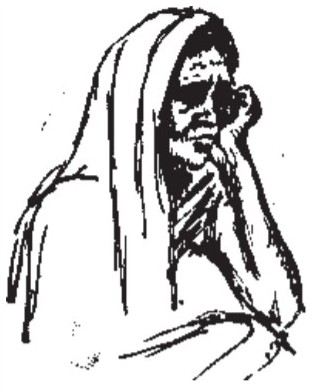
Soma Bua is old.
Soma Bua is deserted.
Soma Bua is alone.
When Soma Bua’s young son died she lost her own youth too. Her husband was so upset by the loss of his son that he left his wife and went to dwell at a pilgrimage centre. There was no one else in the family who could dispel her loneliness. For the last 20 years, nothing had occurred to break the monotony of her life, nothing had changed. Every year, her husband did come and stay a month with her, but she had never waited for him or welcomed him. She became even more depressed when he was with her, because his loveless presence constrained the free flowing stream of her everyday existence. Her movements, visits, outings, all would stop, and the Sanyasi Maharaj could not bring himself to say a few kind words to Soma Bua which might have acted as a support to her in the 11 months of his absence. Therefore, she had to depend on the neighbours for her emotional sustenance. Whenever a naming ceremony or an initiation ceremony, a wedding or a funeral took place in any house, Bua would turn up there and work herself to the bone, just as if she was working in her own, not in someone else’s house.
These days, Soma Bua’s husband is here, and a tiff has just taken place. Bua is sitting in the sun, in the courtyard. She is rubbing oil into her hands, and muttering under her breath. In this one month, all her other organs are forced to remain inactive so her tongue becomes most active and lively. Just then, Radha Bhabhi came down from the terrace, carrying a torn sari and some papads.
“What’s the matter, Bua, why are you upset ? Did the Sanyasi Maharaj say something again ?”
“Arre, he doesn’t like me to go anywhere. Yesterday was the headshaving ceremony of the son of Kishorilal who lives in the square. The whole community was invited. I knew that this inviting the whole community even for a headshaving ceremony was the pride of wealth, but those young daughters-inlaw wouldn’t be able to manage the work so I went early. Of course, I was right.” Bua took the papads from Radha’s hands and began to dry them. “All the work was in a mess. No old woman in the house to give instructions and these young ones have never before managed such an affair.
The singing women were singing marriage songs at a headshaving ceremony.” And this memory dissolved her recent grief and anger. In her natural manner she continued. “Strange things were going on in the kitchen. The samosas were half cooked, and there were enough of them to feed the guests twice ever but the gulab jamuns were too few for even half a row of guests. 1 immediately called for fresh flour and made more gulab jamuns. The two daughters-in-law and Kishorilal were so grateful, poor things! They kept saying : ‘Mother, if it hadn’t been for you we would have been laughing stocks today! Mother ! You have saved our honour.’ I replied that if one’s own people didn’t lend a hand, well, outsiders were not going to come and do it. These days, I am busy at home, preparing his meals, otherwise I’d have gone there first thing in the morning.”
“So why did Sanyasi Mahara get annoyed, Bua ? Does he object to your going out at all?”
“Actually, he does not like me to go anywhere at all, and yesterday, an invitation hadn’t com from Kishori’s house. Arre, 1 say, should one expect an invitation from one’s own family members? They think of me as a mother-why else would they entrust the entire kitchen and storeroom to me? But he refuses to convinced. He tells me:You go around forcing yourself on other people and interfering in their affairs.’ “And suddenly, the angry voice and bitter words that had fallen on her a short while ago came back to her mind.Tears flowed from her eyes.
‘’Arre, Bua, why are you crying ? These scoldings go on, so what ? Sanyasi Maharaj stays here just one month—put up with his scoldings, what else ?”
“I do put up with them, but I can’t help feeling bad that he never speaks kindly, even in this one month. He doesn’t like me to go anywhere. You tell me what you think of this, Radha. He stays 11 months at Hardwar. So he has nothing to do with relatives and kin. But I have to keep up some relationships. Can I get along by breaking off all ties with everyone? I tell him that after all, we are married, so he might as well keep me with him in these last days of life. But he can’t bring himself to do that. He accumulates all the merit, he acquires the name and fame while I am expected to lie here alone, lamenting his absence. And to top it all, he can’t bear the idea of my going out of the house.” With this, Bua burst into tears. “Don’t cry, Bua”, said Radha, consolingly. “He got angry only because you went without an invitation.”
“In that chaos, those poor things forgot to send the invitation. So should I have sat down and sulked ? And who expects an ivitation from family members? I know what closeness means. If someone shows no affection I won’t go even if they send 10 invitations but if they have affection I’ll go running without an invitation. If my own Harkhu had been alive and there was work to be done in his house, would I sit waiting for an invitation ? To me, Kishorilal is just like Harkhu ! Harkhu has gone away—that is why I console myself with other people.” And she began to sob.
Gathering up the dried papads, Radha said tenderly : “Come on now, Bua—how you skip from one pic to another. Do stop crying. 1’ll roast the papads and bring some for you—you must taste them and tell me how they are.” She folded up the sari and went upstairs.
 After a week or so, Bua came along, very cheerful, and said to the Sanyasiji : “Have you heard— some girl from the family of your brother’s in-laws is being married to someone at Bhagirathiji’s house. The whole family is coming here for the -Joke Muylwijk wedding. After brother-in-law’s death, we haven’t had any contact with them, but we are relatives, all the same. They will be sure to invite you too.How can they leave out relatives ?” And Bua laughed with pleasure. She did feel hurt by Sanyasiji’s silent indifference yet she was happy. In the next few days, she went around, gathering the latest news of the progress of arrangements. One day, she heard that their relatives had actually arrived. Preparations were going on full swing. The whole community would be feasted—it would be a grand affair. Both families were wealthy.
“Who knows’whether or not our family will be invited ? Brother-in-law died 25 years ago and after that, we have had no contact. How could we keep in touch ? That is a man’s job. Though I have a husband I am as good as a widow.” And she sighed deeply.
“Come on, Bua ! How can you not be invited ? You are a close relative ! Relationships don’t break off just because one doesn’t keep contact”, the oldest daughter-in-law of the house said, as she ground the lentils.
“Your name is there, Bua”, said the widowed daughter of the house, “I’ve seen the whole list.” Bua, who was squatting on the floor, moved forward eagerly. “You’ve seen the name with your own eyes ? Well, the name should be there. But I wondered whether these newfangled people would invite old relatives or not.” Without waiting for an answer, Bua set off.
As soon as she reached home she went straight up to Radha Bhabhi’s room. “Listen, Radha, you must be knowing what is given to a bride, according to the new fashion ? It’s a matter of relatives, and wealthy ones too. It won’t look right for me to turn up emptyhanded. I am old fashioned. You tell me what should be given ? There’s no time now to get anything made. Two days are left, so buy something readymade.”
“What would you like to give, Mother—jewellery or clothes or a jewel box—or something in silver ?”
“I don’t have any understanding of these things, child. I’ll give you whatever money I have and you buy whatever you think fit. I shouldn’t become a laughing stock, that’s all. All right, let me first see how much money there is.”
She went downstairs with tottering steps. She moved aside two or three bundles of clothing, took out a small box and unlocked it. After some searching, she extracted a tiny box from it. With great effort she managed to open this. In it lay seven rupees, some change and a ring. Bua had thought there would be more money but when only seven rupees emerged she fell to thinking. In those wealthy people’s house, more money would be spent even on a bindi. She looked at the ring. This was the last token she had left of her dead son. Even in times of grave financial crisis, she had not been able to get over her fondness for that ring. Today, too, when she picked it up her heart gave a great throb yet she wrapped five rupees and the ring in a corner of her sari. She closed the box and went upstairs but this time her enthusiasm had dwindled and her feet moved less swiftly.
Going to Radha, she said : “There isn’t much money, daughter-in-law. Where am I to get money from—I have no one to earn for me. All I have is the rent from that room and I can barely manage two meals a day on that!” And she began to cry. “What to do, Bua”, said Radha, “These days, I too am living from hand to mouth otherwise I’d have done something about it. But why do you worry yourself over a gift ? These days, that custom of giving and taking gifts is not observed any more.”
“No, no, Radha. They are in-laws, after all. Though 25 years have passed, they have not forgotten us. How can I go empty handed ? It would be better not to go at all !”
“Then forget about it. That’s the simplest way out. In the crowd, they won’t even notice who came and who didn’t.” Radha seemed to think the problem was solved.
“They’ll feel very bad. The whole city will be there. If I, a relative, don’t go, they’ll think we don’t acknowledge the relationship any more, just because brother-in-law is dead. No, no, you sell this ring.” Opening the knot in her sari, she took out an old fashioned ring. Handing it to Radha, she said in a pleading tone : “You do go to the market, Radha. Please sell this and buy whatever you think suitable. Just see that it looks decent.”
When Bua heard the bangle seller’s call in their lane, her eye fell on the ugly, mud coloured bangles on her wrists. Tomorrow, she had to go to her relatives’ house. She had no jewels but the least she could do was wear nice glass bangles. But an inexpressible shyness held her feet back. What if someone saw her ? The next moment, she conquered this weakness, went to the back door, and bought a rupee’s worth of red and green bangles. But she covered her wrists with her sari, all day.
In the evening, Radha Bhabhi gave Bua a sindur box, a sari and a blouse piece. Bua was very pleased and enjoyed thinking how the women of the other family would remember old days and would praise her sociable nature. She even began to forget the sorrow of having sold the ring. At night, she bought an anna’s worth of yellow dye from the nearby grocer and dyed her sari. It would not do to attend a wedding in a white sari. When she lay down to sleep her mind raced towards the next day.
The next morning, she finished all the cooking by nine’ o’ clock. But her dyed sari did not look satisfactory. Once more, she went upstairs to Radha. “Listen, Radha, when you wear dyed saris they look very good. They shine. But this one has no shine.”
“You didn’t starch it, Mother, that’s why. Starch it now—it’ll be all right. What time have they asked you to be there ?”
“You know these new fangled people— the invitation comes at the eleventh hour. The auspicious time is five in the evening. So the invitation may come any time in the day.” Radha Bhabhi could not help smiling to herself.
Bua starched the sari and hung it out to dry. Then she took out a new steel plate and a small napkin crocheted in the days of her youth. She arranged the sari, the sindur box, a coconut and a few sweets on the plate, and took it up to show Radha. The Sanyasi Maharaj had been watching all the preparations and in these two days, he had issued a warning about 25 times that if no one came to call her she should not go, that would not be proper. Each time, Bua replied with great confidence: “Do you think I am a mad woman to go without being asked? Our neighbours’ daughter has seen with her own eyes the name in the list of invitees. And why shouldn’t they invite us? Do you think they’ll invite all and sundry from the city, and leave out their relatives?”
Around three in the afternoon, Radha Bhabhi saw Bua wandering about restlessly on the terrace so she called out: “Still here, Bua?”
 Bua replied with a start: “What’s the time, Radha? What did you say—three? In winter, the day goes by before one knows it. It’s only three but the sunlight has shrunk into a corner of the roof as if it were already evening.” Then, as if she had suddenly remembered that this was no answer to Bhabhi’s question, she said in a somewhat depressed tone: ‘The auspicious time is five. If I go, I’ll go at four. It’s only three just now.” She was careful to infuse a certain indifference into her tone. Bua stood on the rooftop, her eyes scanning the alley
When Radha glanced upwards, through the dusk at seven, she saw a shadowy figure on the roof, pressed to the wall, its face turned towards the alley. Her heart overflowed. Without asking any questions, she just said : “Bua ! What are you doing, standing there in the cold ? Won’t dinner be cooked tonight—it’s past seven.”
As if awakened suddenly from sleep, Bua said: “What did you say, seven ?” Then, as if asking herself, she continued : “But how can it be seven ? The auspicious hour was five.” And then, suddenly understanding the whole situation, and compelling her voice to sound natural, she said : “Dinner will be ready soon enough. It’s only for two, after all. How long does it take to cook it and eat it ?”
Then she took down the dry sari. She went downstairs, folded the sari, and slowly removed the bangles from her wrists. With great care, she placed in her trunk all the things that were arranged in the steel plate.
Then, with a crushed heart, she set about lighting the fire.
(translated from Hindi by Manushi)

