
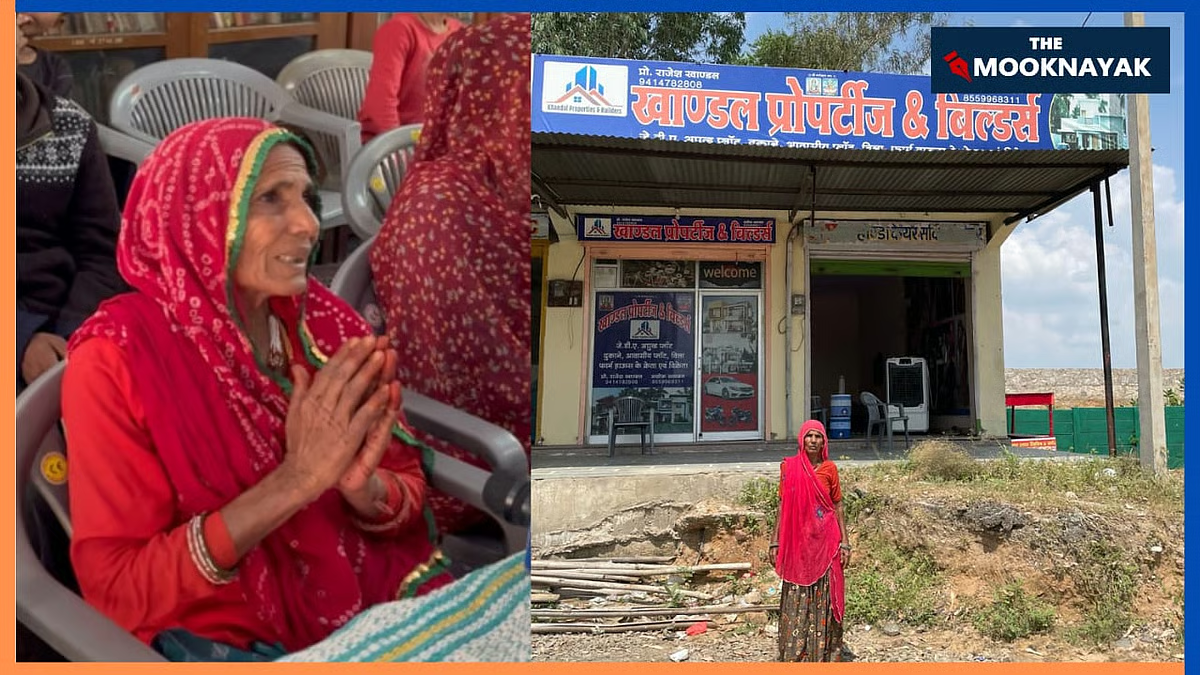
85-Year-Old Widow Santra Devi’s Battle for Reclaiming Her Land
Machwa village, on the outskirts of Jaipur, is a landscape in transition, half rural, half swallowed by the city’s restless expansion. Tin-roofed homes, dusty lanes, cows tied under neem trees, and half-built shops stand where fields once ripened. Amid this restless change lives Santra Devi, an 85-year-old widow who has spent more than a decade fighting to reclaim the land that once gave her family both food and dignity.
When I met her, she was sitting outside her tin-roofed shelter, her back slightly bent but her voice steady. On her lap lay a faded red cloth bundle, her “documents,” she said, the only proof she still holds of the two bighas of land once allotted to her husband under a government scheme for landless families.
“This was our only security,” she told me quietly. “Now it’s all gone, sold, built over, and I’m still running from one office to another.”
A Land That Vanished on Paper
Her husband passed away in 2013. Two years later, two housing societies, Vijaypura Grih Nirman Sahakari Samiti and Sirohi Grih Nirman Sahakari Samiti, produced sale deeds claiming he had sold his land to them. The problem was obvious even to a layperson: the dates were after his death, the signatures forged, the stamps missing, and no Collector’s permission was taken, a legal requirement for any such transfer.
Yet the system accepted the papers. The land changed hands multiple times, each sale resting on the last set of forged documents. The fields that once grew wheat and bajra are now a row of 23 commercial shops. Locals say the shops have been sold and resold so many times that tracing ownership is impossible. Today, the property stands under the name of Kedia Builders, who plan to turn the area into a shopping complex.
“The land where my husband worked will now have showrooms,” she said, glancing at the new concrete structures across the road. “They took everything, but I am still waiting for justice.”
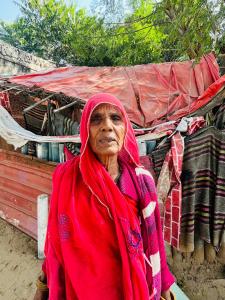
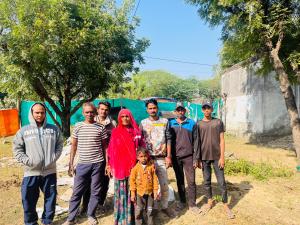
Photo on the left: Santra Devi outside her makeshift bamboo hut. On the right: Santra Devi with her relatives
The Long Road Through Offices and Files
For over ten years, Santra Devi has carried her worn file from one office to another, the Tehsildar, the Collector, the Jaipur Development Authority, the Chief Minister’s office, even the Scheduled Castes Commission. She has filed petitions, met officials, and lodged police complaints.
Everywhere, she was told to “wait.” Some nodded sympathetically, others avoided her eyes. A few officers even advised her to “let it go.” But she refuses.
She walks slowly now, with a stick, often accompanied by one of her nine children, but her determination hasn’t dimmed. “They think I’m old and tired,” she said, “but if I stop now, I will die before my time.”
The Weight of Widowhood
Santra Devi’s story is not just about lost land. It’s about what happens when a woman loses her place in the world after her husband’s death. In villages like Machwa, widowhood often strips women not only of companionship but also of visibility. Without the presence of a man, they become easy to ignore, even easier to dispossess.
She tells me how, in the early years after her husband’s death, no one took her complaints seriously. “They told me, ‘Who will listen to an old woman?’ But I couldn’t keep quiet,” she said. “That land was my husband’s life.”
Her nine children, all struggling with daily-wage work, sometimes urge her to rest, to forget the past. But for her, this fight has become her last purpose.
Women, Land, and the Idea of Justice
Over decades of meeting women like Santra Devi, I have learned that for them, land is never just property. It is identity, stability, and pride. Losing it feels like being erased from the world twice, once by death, once by deceit.
When land reform laws were introduced, they carried a moral promise, that no family would live without dignity. That promise has withered in the maze of bureaucracy, where forged documents and builder lobbies often speak louder than truth.
A retired revenue official in Jaipur put it bluntly: “Once construction begins, no one wants to undo it. The poor have to prove they exist. The powerful only have to show papers.”
The Woman Who Refuses to Vanish
Despite her frailty, Santra Devi’s defiance carries quiet power. She still walks to government offices, waits in corridors, and guards every acknowledgement slip as if it were gold. Local activists and journalists have taken note, but the machinery remains unmoved.
The irony is painful, a piece of land meant to empower a poor widow has been turned into a commercial hub, while the woman it was meant to protect lives in a shack by the roadside.
Yet, she has not surrendered. “They may build malls where my crops grew,” she said, “but they can’t take my courage.”
As I left Machwa, the sun dipped behind the rows of new shops, neat, polished, and utterly indifferent. Behind them sat an old woman with a cloth bundle on her lap, still holding on to a world that refuses to remember her.
In her silence lies a question India has not yet answered: What does progress mean when the women who built this land are left standing outside its gates?

