

At the Kadri Manjunath Temple in Mangaluru, Arshiya Khan appeared as Sri Devi in a performance of Devi Mahatme, wearing the crown of the eight-armed goddess. In the Yakshagana world, she is known as Tanu Vittala. She is Muslim, while the goddess she portrayed is central to Hindu belief. The performance drew attention. But to see it merely as an unusual event is to miss something fundamental about Yakshagana. This traditional theatre form does not bring communities together through declarations or campaigns. It gives everyone a way to participate: a character to perform, a rhythm to keep, or a place in the courtyard to watch.
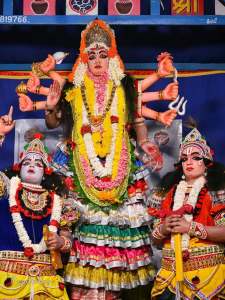
A Yakshagana performance of Devi Mahatme, with Sri Devi in her eight-armed form. Photo: Daya Kukkaje
The stories performed in Yakshagana come from the Ramayana, the Mahabharata and the Puranas. Gods, demons, kings and warriors take the stage. Yet the people who perform and watch these stories do not all share the same religious identity. Some discover the art through a school annual function in childhood. Others leave for work abroad but return to it. Some families have invited Yakshagana troupes into their homes for generations. These different paths bring Hindus, Muslims and Christians into the same cultural tradition.
Mohammed Ghouse, from Kavradi near Kundapur, has been performing Yakshagana for five decades. His family sent him to Saudi Arabia for work. Even after spending seven years there, his attachment to the art remained strong. He returned and resumed his involvement with Yakshagana. With the Madamakki Veerabhadreshwara Yakshagana troupe, he performed characters such as Arjuna and Bhasmasura. One is the archer from the Mahabharata; the other is a demon destined to fall in the story. Ghouse has also performed in both major styles of Yakshagana found in coastal Karnataka, Tenkutittu and Badagutittu. His commitment to both styles suggests that this is not a passing interest but a lifelong relationship with the art.
That relationship has also come at a cost. According to Ghouse, some relatives distanced themselves from him because of his involvement in Yakshagana, and this affected his family as well. Yet he did not give up performing. “Caste and religion are man-made,” he has said. He wants to remain associated with Yakshagana until his last breath. These are not the words of an outside observer, but of someone who has spent a lifetime negotiating the demands of training, performance and social resistance.
Arshiya’s journey began differently. As a child in Mada, near Vittala, she watched a Yakshagana performance in her area and was drawn to the art. When she was around ten, a schoolteacher taught her Yakshagana for the school’s annual function. Her first opportunity, then, came not through a temple or a traditional family lineage, but through a school. She later trained at Kadali Kala Kendra in Mangaluru and established her stage identity as Tanu Vittala.
She was especially drawn to Bannada Vesha, the colourful costumes and make-up associated with demons and villains. She performed Mahishasura, Nishumbha and Raktabija. She also wanted to learn the chende, a percussion instrument used in Yakshagana. Her interest extended beyond the visible drama of the stage. She wanted to understand and participate in the work that creates its rhythm.
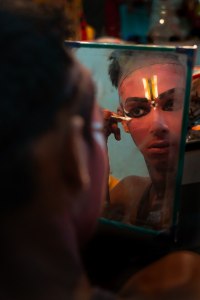
A Yakshagana artist applies make-up before a performance.
There is a detail worth considering here. In the story of Devi Mahatme, Mahishasura, Nishumbha and Raktabija are opponents of the goddess. Arshiya performed these roles and later appeared as the goddess herself. In Yakshagana, different performers take on gods and demons, and doing justice to a character requires practice and discipline. Yet participation is not always accepted so easily outside the stage. Arshiya faced objections from some members of her community, although her family supported her. Women have also historically had limited opportunities in Yakshagana. Her journey therefore involved negotiating both religious and gender-based boundaries.
Yakshagana’s connections extend beyond performers. In the Malpe area of Udupi, the Chimmela troupe of the Badanidiyoor Gajanan Yakshagana Kala Sangha performs in homes during Navratri, following invitations from families. The tradition is more than six decades old. The troupe visits Hindu households as well as Muslim and Christian homes. Here, Yakshagana moves beyond a public stage and enters the courtyards of ordinary homes.
Sarfaraz, from Vadabhandeshwara, has described his family’s relationship with the tradition in simple terms: “Our family has enjoyed Yakshagana for generations.” According to him, the Gajanan troupe had been performing for his family since his grandfather’s time. The family members sit together to watch Chimmela. What stands out is the ordinariness of this relationship. There is no campaign or slogan about shared culture. One family extends an invitation, and the troupe arrives. A bond built over generations is explained through memories of grandparents, not through an ideological declaration.
Taken together, these three stories reveal a pattern. Ghouse must master his characters, Arshiya works on her acting and wants to learn the rhythms of the performance, while Sarfaraz’s family needs only to gather and watch. Each relationship with Yakshagana is different, but all involve participation in the same tradition. One person joins as a performer, another as a learner and actor, and another as part of a family audience.
This does not mean Yakshagana exists in a world free of religious or social tensions. Both Ghouse and Arshiya have faced opposition. The desire to take part in a cultural tradition and the acceptance of that choice within one’s community do not always go together. Their experiences make it clear that the boundaries are real, even when people cross them.
Yakshagana’s strength lies not in abandoning its stories or cultural roots. The stories remain the same, as do the gods and demons who inhabit them. Its significance lies in the fact that the people who bring these stories to the stage, watch them and invite them into their homes can belong to different communities. Their identities do not disappear, but they can find a shared space within the same tradition. That space is where Yakshagana’s social significance lies.
Shirish Khare is an independent writer and journalist who has written on rural India, social life, rural livelihoods, migration and public institutions. His Hindi books include ‘Ek Desh Barah Duniya’ and ‘Nadi Sindoori’, a collection of short stories.

